


Documentary Film making Course in mumbai.
We are accepting applications for the next academic session .
1. No of Seats: 10 seats to be filled on an interview basis for Indian students. We have 2 Seats for International Students & 3 Seats for Management representation Students.
2. Eligibility Criteria: Minimum qualification is 10+2 -for a "Diploma" certificate. Graduation in any discipline is required for a "PG Diploma” certificate. No minimum percentage is required to apply. Students who are appearing for their 12th/final year exam of graduation can also apply. Course content and classroom remain the same for the main course.
3. Selection Criteria for Course: Selection is done on the basis of an interview, which will happen on campus only. Results are declared within 3 days after the interview. Selected candidates have to submit the seat confirmation fee within 5 days from the date of declaration of the result. The students on the waiting list will be declared in the last week before the session starts.
4. How to Apply: In order to study photography in CRAFT,You need to apply online from the website given below-
https://www.craftfilmschool.com/applyonline.
The amount of Rs .1,000/- as an application fee has to be paid by Debit Card/Credit Card / UPI / Net banking. If you are coming personally to CRAFT, you can also pay in cash.
5. Last Date to Apply for Course :
We are accepting applications for the interviews to be conducted every altearnate week .Kindly note that 33% seats are filled in the in the 2 interviews held every month.Interviews are conducted in May, June, July every year.
We have allocated 10 Points for overall performance. Sincerity score: 2 points | Academic Record: 2 points | Portfolio: 2 points | Interview Performance: 4 points. The candidate needs to score a minimum of 6 points to qualify for admission in CRAFT. Hence if you are making an inquiry today, you need to apply within 3 Days to gain a Sincerity score of 2 points- which will qualify you as a “Sincere Candidate”.
6.How to prepare for an interview: The main intention of the interview board is to see whether the student is really passionate about the field of study he/she has applied for.
7. Hostel Facilities: We don’t have a hostel, but our student’s coordinator help in finding economical accommodation at walking distance from the institute. It saves traveling time and cost- an average of Rs 2500/-per month! Generally, rooms cost between Rs. 5000/- and 6000/- per month which, on sharing basis, costs around Rs. 3,000/- per month. A food joint is a nearby CRAFT where most of the students have their lunch and dinner. We help in finding PG accommodation for the girl candidates. It costs around Rs. 5000/- per month. Food is separate and Tiffin service is available.
8. Course Fee: The total fee in lump sum mode is Rs. 1,50,000/-.
In the installment method:1,55,000/-
1) 50% of the total fee 30 days before the academic session starts.
2) 25% as 2nd installment to be paid after 1 month of starting the Academic session.
3) 25% as 3rd installment to be paid after 2 months of starting the Academic session.
Students who opt for the Instalment method needs to deposit the Post Dated Cheque ( PDC ) of the above dates at the time of joining.
9. Class Timings: Our motto is to ‘Learn by Doing’. Class Timings: ‘Learn by doing is the main philosophy of the center. Classes take place in two shifts from 10:00 am to 1:00 pm / from 2:00 pm to 5:00 pm (1:00 to 2:00 is the lunch break) with 30 minutes tea break in both the shifts (five days a week). We have a studio in which we conduct daily practicals of 3 hours. The theory class is for 2 hours once a week.
First two-month teaching plan:
10:00: 1:00 pm ............ Editing +
2:00: 5:00 pm ..................Cinematography
For 2-Months there would be Camera and Editing Classes from 10.00 am to 1.00 pm and 2.00 pm to 5.00 pm, 5 days a week.
3rd-month teaching plan:
Documentary lectures on scripting:
Week -1
3 - Days classes of 2 hr each. by 1st -Documentary filmmakers.
2-days sound recording exclusive on location sound
Week -2
3 - Days classes of 2 hr each. by 2nd -Documentary filmmakers.
2-days sound recording exclusive on-location sound- cleaning, and effects track laying
Week -3:
3-days 2.5 hr. each -workshop on location sound recording for documentary film making by Shivdas, location sound expert.
Week -4:
# Documentary project discussion with a mentor about the script:
# Documentary Film making project schedule of 12-days plan:
No of shooting days: 5
No of Editing days: 5 (8-hr each day)
No of Sound studio post Production: 2 (4-hr each day)
Final Sound Mixing & editing output: 1-day: 8 hrs.
11. CRAFT’s Legal Status & Affiliation: CRAFT is registered as a nonprofit-making public charitable trust with Sub-Registrar in the Delhi government. We offer autonomous Diploma courses. Proudly established in the year 2006 (March 6) - 2020 is our 14th year of operation.
12. Workshops: various workshops are conducted by guest faculty of various news Channels.
13. Bank Loan Provision: We do not have tie-ups with any bank, but if you apply for a Student loan, we can issue a letter required from our end.
14. Management Quota Seats: There are 3 management quota seats available in this course in which students can seek direct admission without an interview. One has to pay an additional Rs. 20,000/- (for blocking the seat) besides the regular fee.
15. Placement Support: we help you conncet with Freelance documnetry film maker.
Apply Now!
https://www.craftfilmschool.com/applyonline
cell+whats app...png) ..9910161695
..9910161695
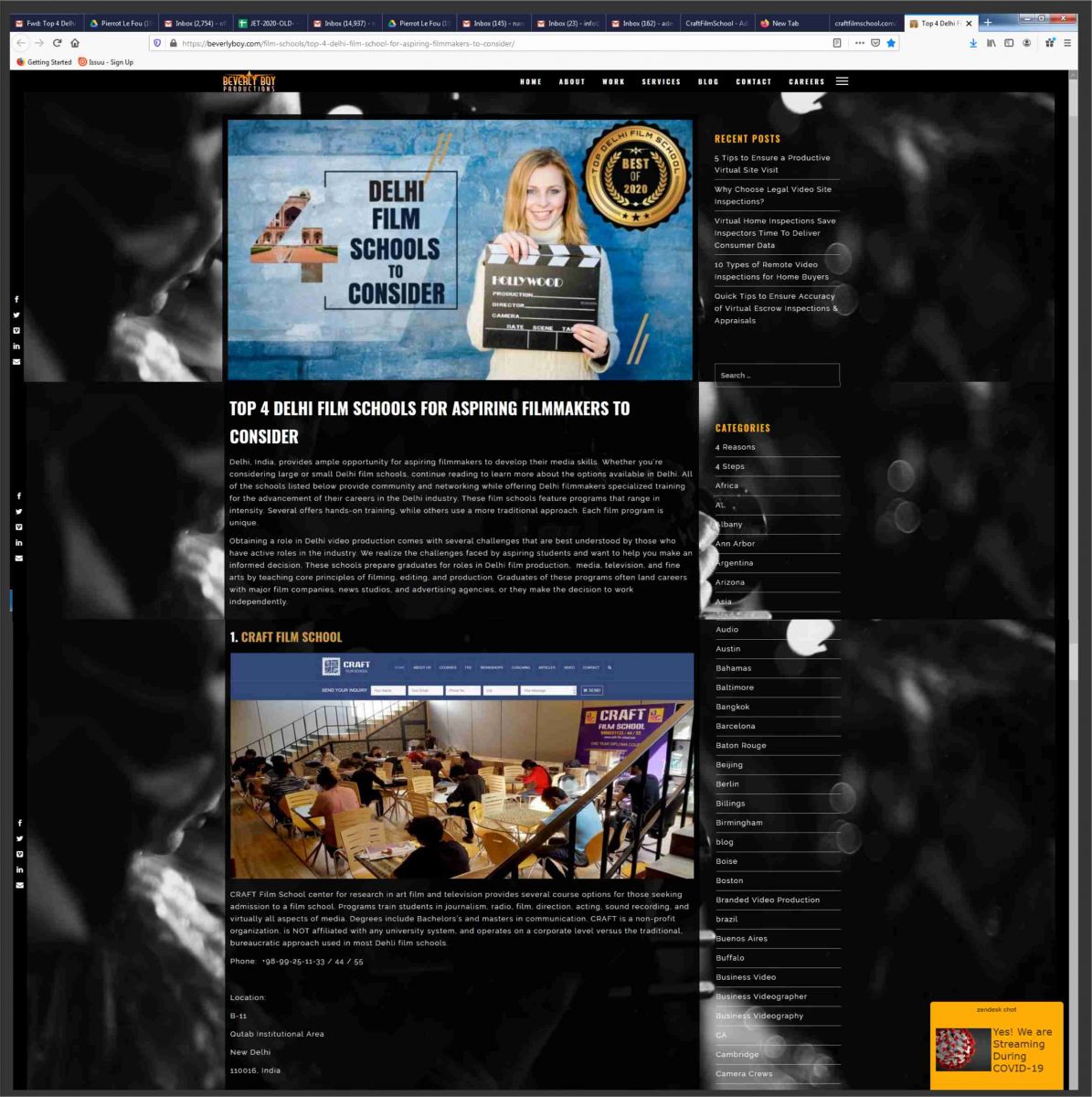
In meticulously compiled a list recognizing who are the "Top 4 Film Schools". CRAFT Film School for being featured as #1 on their list!
click here to read more about it
Equipment available in sound studio of craft. 1.recording equipment. 2.daily Practising equoipmnet
Faculties Available for editing documentary film
various shooting equipment to the students
SOUND EQUIPMENT IN craft
A documentary filmmaking course teaches students how to research, plan, shoot, and edit non-fiction films. Students learn storytelling, interviewing, camera techniques, and editing skills specific to documentary production.
These classes are ideal for aspiring filmmakers, journalists, and storytellers interested in non-fiction content. Students gain skills in research, narrative development, and visual storytelling for real-world subjects.
Students learn camera operation, lighting, sound recording, editing, and directing for non-fiction projects. Courses also cover ethical storytelling, scripting, and distribution strategies for documentaries.
Courses can range from short workshops of a few days to diploma or degree programs lasting six months to two years, depending on the depth and practical exposure provided.
Yes, many institutes and platforms offer online documentary filmmaking courses. Online programs provide video lessons, assignments, and feedback while covering research, production, and post-production techniques.
Beginners learn the basics of research, storyboarding, camera use, sound recording, and editing. Students often work on short documentary projects to apply their skills practically.
Documentary courses focus on real-life stories, interviews, and non-fiction storytelling. Feature filmmaking emphasizes scripted narratives, actors, and fictional storylines.
Workshops provide hands-on experience with camera work, editing, and storytelling. Students also get mentorship from experienced documentary filmmakers and receive feedback on their projects.
Courses teach editing and post-production using software like Adobe Premiere Pro, Final Cut Pro, DaVinci Resolve, and After Effects for color grading and sound design.
Yes, students gain skills to produce, shoot, and edit their own documentaries. Practical assignments guide them from idea development to final distribution-ready films.
Graduates can work as documentary filmmakers, editors, producers, journalists, or content creators. Opportunities exist in media houses, streaming platforms, NGOs, and independent production.
Documentary storytelling involves presenting real events or subjects in a compelling narrative. Students learn structuring interviews, archival material, and visuals to create engaging non-fiction stories.
Students explore various forms like observational, participatory, expository, and experimental documentaries. Each type requires unique shooting and editing techniques.
Research is critical to uncover accurate facts, identify subjects, and create engaging stories. Courses teach students effective research, interviewing, and fact-checking methods.
Editing classes teach how to structure footage, incorporate interviews, add graphics, and create smooth storytelling. Students learn pacing, sound design, and color correction for professional documentaries.
Yes, students learn camera techniques, framing, lighting, and composition tailored for non-fiction storytelling. Cinematography skills help capture real-life events with visual impact.
Some platforms provide free tutorials and short courses on documentary filmmaking basics. However, structured paid courses offer comprehensive training, feedback, and project guidance.
Workshops are short-term and focus on specific skills like editing or shooting techniques. Full courses provide in-depth training from research and scripting to production and post-production.
Students develop storytelling, camera handling, sound recording, interviewing, editing, and research skills. They also learn project management and ethical filmmaking practices.
These courses provide practical experience, technical skills, and a portfolio of projects. Graduates can work in journalism, independent film, TV channels, streaming platforms, or NGOs producing documentary content.
 Seats : 10
  Duration: 1 YEAR
 Intreview : Every Alterante Week
 Helpline: 9910161695